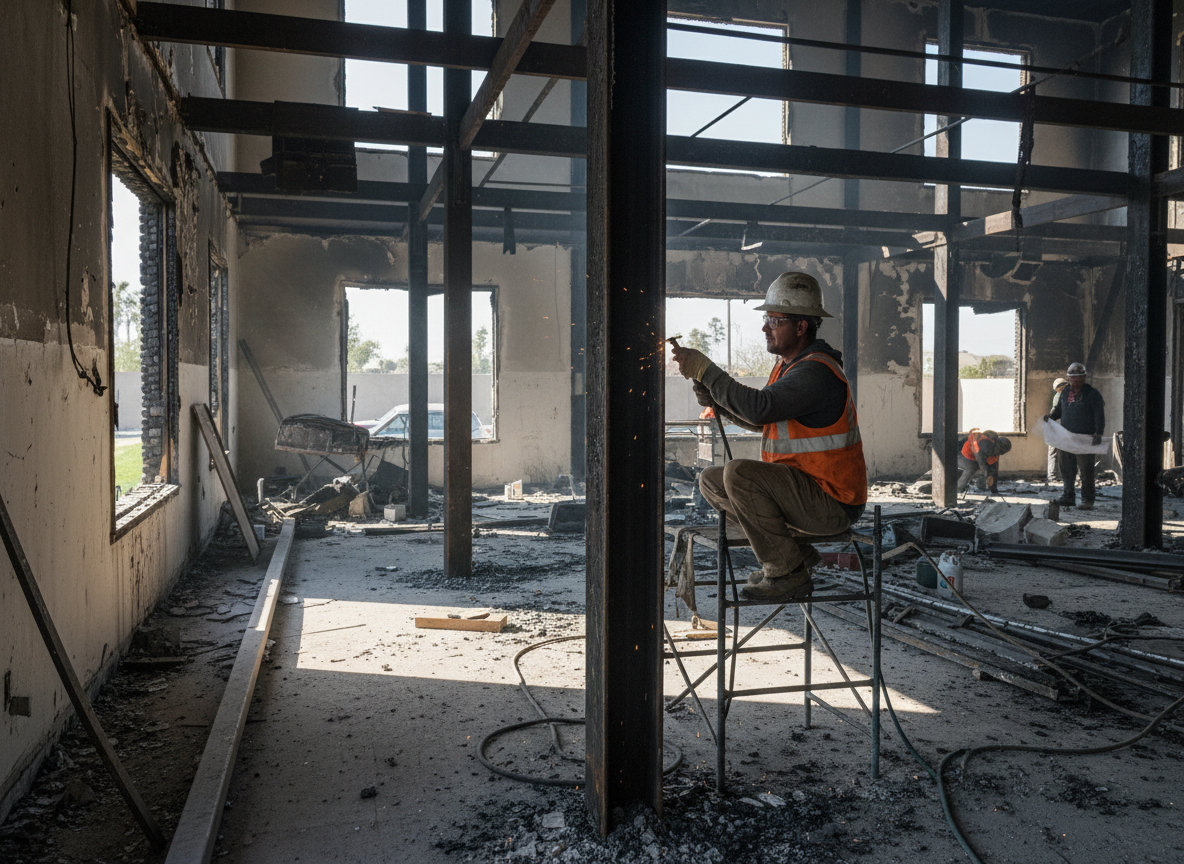
Mira Loma’s older single-family homes in Downtown Mira Loma often feature dimensional lumber framing from the 1960s and 1970s that can hide hidden charring behind drywall once a fire is extinguished. Hot desert summers push daytime temperatures above 100 degrees, which accelerates drying of any water used during suppression and can cause rapid checking in exposed beams if not addressed immediately. Structural repair after fire begins with shoring unstable sections, then selective removal of compromised joists and rafters before sistering or full replacement with pressure-treated lumber that meets current Riverside County seismic and fire-code requirements.
Smoke and heat can degrade engineered floor systems common in newer tracts near Eastvale and Jurupa Valley, leaving subtle delamination that only shows under load testing. Technicians must also account for Wine Country’s occasional Santa Ana wind events that drive ember intrusion into attics, requiring full ridge-to-eave inspections rather than spot repairs. All work follows California Residential Code sections on fire-damaged structures, including verification that repaired assemblies maintain the required one-hour fire rating where homes sit within 10 feet of neighboring properties.
Soil conditions in the Mira Loma area include expansive clays that shift with seasonal moisture changes; any foundation or sill plate replacement must include proper drainage re-grading to prevent future movement. Edge cases frequently involve post-fire mold growth inside wall cavities when humidity spikes after monsoonal rains, necessitating simultaneous moisture mapping and antimicrobial treatment before drywall is reinstalled.
Final inspections coordinate with Riverside County Building Department to confirm that load paths are restored and that any added steel connectors meet current standards for high-wind zones.
Technician insight
In Mira Loma the thing that catches most people out with Structural repair after fire is the way our hot desert summers dry out suppression water so fast that you miss hidden mold in the rim joists until the new drywall goes up. Older homes near Mira Loma Park often have 2x8 floor joists spaced 16 inches that look solid from below but have lost 30 percent of their strength from hidden char; you have to pull baseboards and run a borescope or the next owner will feel the bounce.
Downtown Mira Loma kitchen fire
A kitchen fire in a 1970s home off Limonite Ave left the ceiling joists heavily charred. Inspection revealed heat damage extending into the attic and one load-bearing wall. Crews shored the roof, replaced six compromised joists with pressure-treated lumber, added new fire-blocking, and restored the ceiling assembly to pass county inspection.
How it works
- 1
Initial Shoring and Safety Assessment
Install temporary supports to stabilize compromised walls and floors, then document all visible and hidden damage with moisture meters and borescopes.
- 2
Selective Demolition and Material Evaluation
Remove charred or smoke-weakened lumber while preserving sound sections, testing remaining joists and beams for structural integrity.
- 3
Code-Compliant Replacement
Sister or replace framing members using pressure-treated or fire-retardant lumber, adding required connectors and fire-blocking to meet Riverside County standards.
- 4
Finishing and Verification
Reinstall insulation, drywall and finishes, then schedule final inspection to confirm load-bearing capacity and fire-rated assemblies.
Pricing
Upfront written quotes after on-site inspection; final cost depends on extent of hidden damage and required engineering stamps.